The Problem with Weather Apps
Intro
There's a particular kind of frustration that only people who depend on weather really understand.
You wake up early, make a coffee, open two or three weather apps and start doing the usual routine: wind graphs, maps, rain radar, switching models, trying to make a call from a bunch of numbers.
And what you're really trying to answer is one simple question:
When and where is it good for what I want to do?
Not “what's the weather doing?” Not “what's the temperature at 3pm?” Just: is it on - or not?
A life built around wind
Over the years I've been lucky enough to be involved in a few airsports: paragliding, skydiving, speedflying, and more recently BASE jumping.
They're all different, but they all share the same dependency: the right conditions. Too windy, wrong direction, rain moving in, gusts too high - it doesn't matter how motivated you are, you're not going.
Living in the UK doesn't make it easier. You can have nothing usable for days and then, randomly, a narrow window appears on a Tuesday afternoon. If you miss it, you miss it.
I've spent an embarrassing amount of time over the years checking forecasts, trying to work out in advance when and where things might line up. Eventually it clicked that I wasn't really interested in “weather” - I was interested in opportunities.

The problem with weather apps
Weather apps are impressive now. The maps are beautiful, radar is sharp, and switching between models is easy.
But almost all of them assume the same thing: that you want to see weather data.
I don't. I want to go flying.
Weather is just the constraint between me and the thing I care about.
Most other types of software have moved beyond simply presenting raw information. Accounting software doesn't just list transactions - it gives you forecasts and highlights problems before you run into them. Budgeting apps don't just show your balance - they tell you if you're on track. Sat-nav doesn't just display a map and traffic - it tells you the best route and when to leave.
They take data and turn it into a decision.
Weather apps mostly still stop one step earlier. They give you wind speeds, gusts, rainfall percentages and model comparisons - and expect you to synthesise it all yourself.
That gap between data and decision is exactly what I wanted to fix.
Weather apps mostly still present information and leave the interpretation to you. So you end up mentally combining wind speed, direction, gusts, rainfall probability, time windows, daylight hours, and location - and then deciding if it's good enough. And you repeat that process again tomorrow.
The core question never changes: when and where is it good for what I want to do?
The hacks before PrimeWindow
I've tried to solve this for myself more times than I can count.
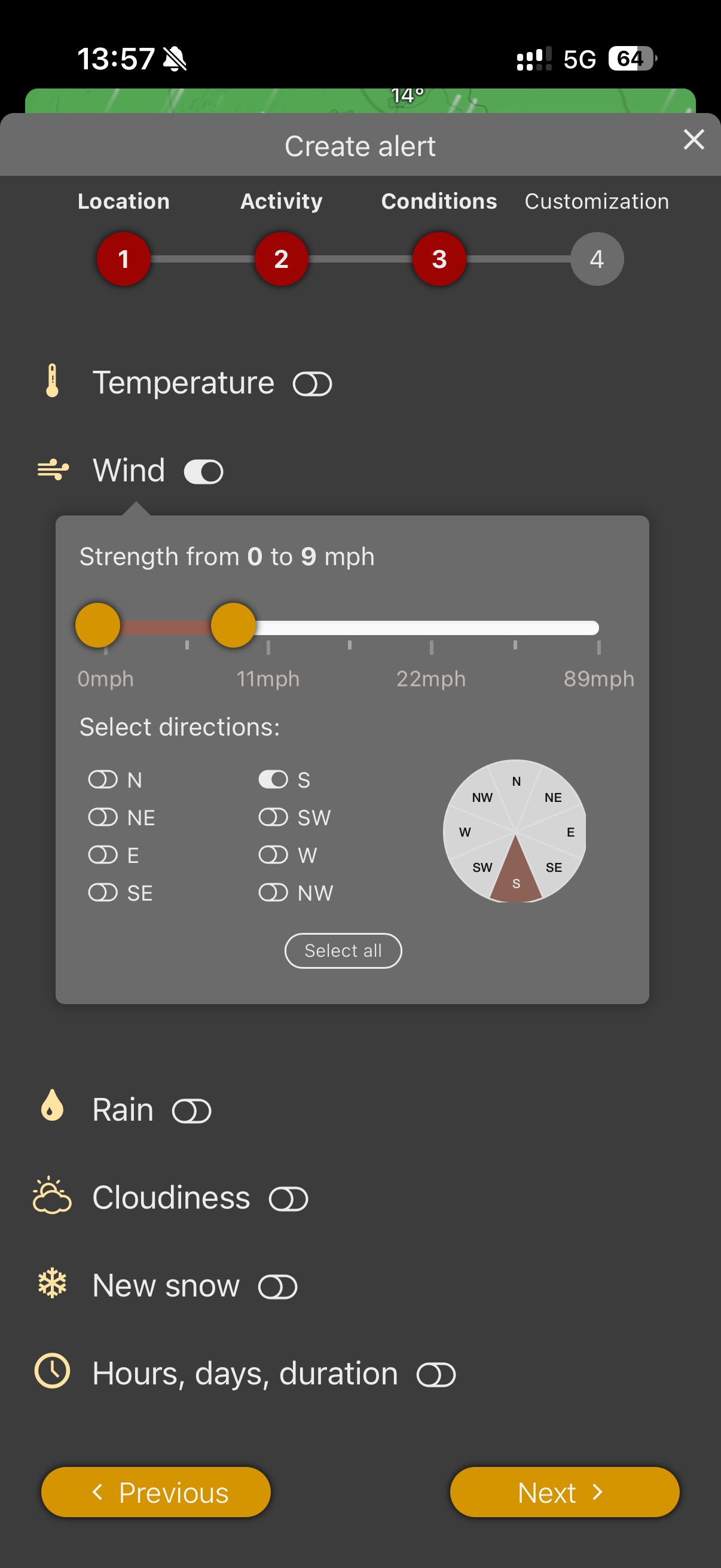
I've used alert features inside apps like Windy. They work, but they often feel bolted on - buried in menus, limited, awkward to manage across multiple locations, and never quite the main point of the app.
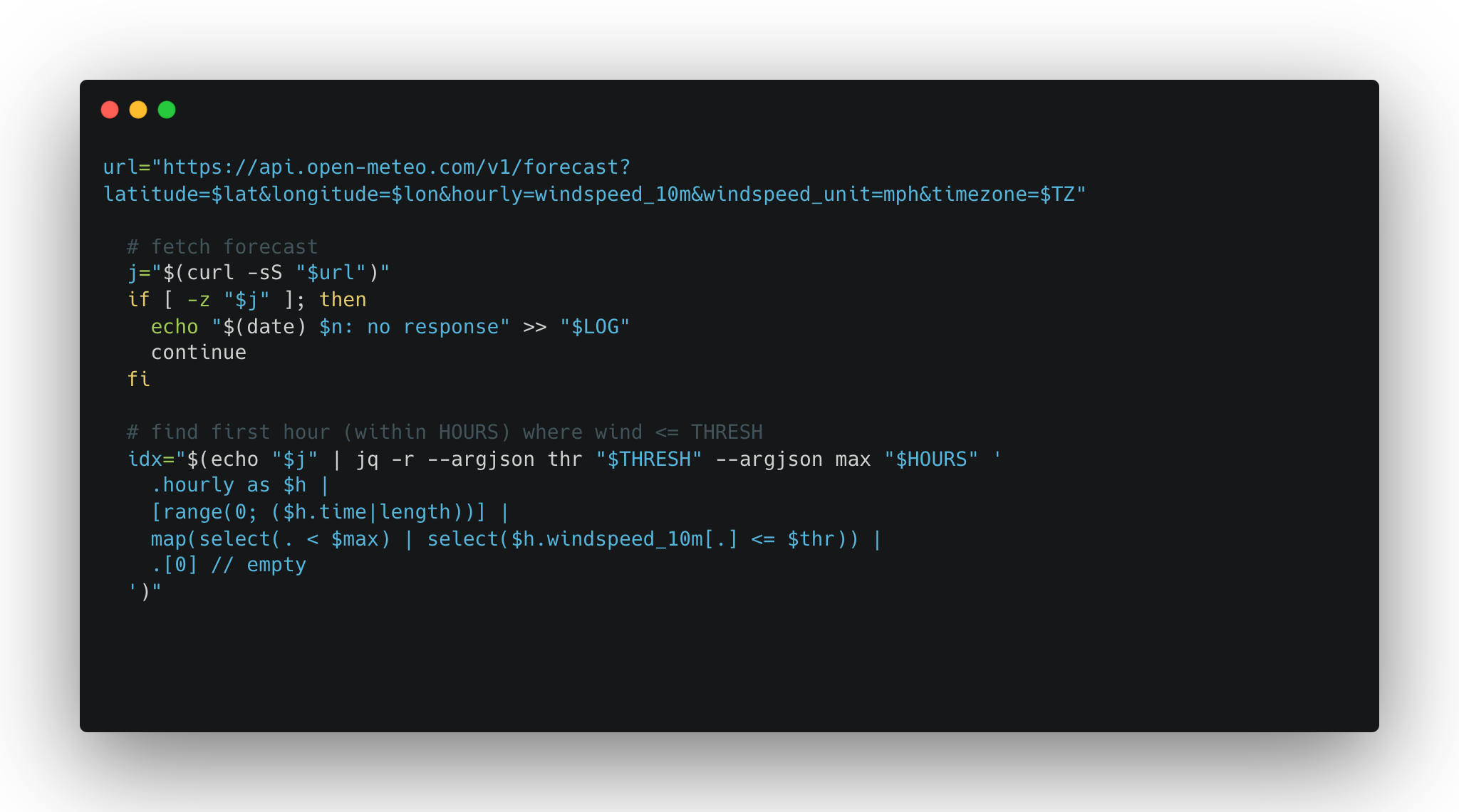
Then I went full engineer about it. Bash scripts on cron jobs, pulling weather APIs and sending push notifications via ntfy.sh. It worked... until it didn't. It was brittle, adding locations was a faff, tweaking conditions wasn't friendly, and sharing a window with friends in a WhatsApp group definitely wasn't smooth.
A couple of years ago I started building an iOS app to do it properly. I'm an iOS engineer professionally, so it felt like the obvious route. I got pretty close, then life happened - family, work, other commitments - and the project sat half-finished.
Recently, with tools like Codex and Claude speeding up development, I picked it back up. This time I kept it simple and stayed stubbornly focused on the core problem.
What PrimeWindow is (and isn't)
PrimeWindow is not another weather app.
It doesn't try to replace your favourite forecast tool. It doesn't show radar or big scrolling charts. It's not competing on visualising data.
Instead, you tell it:
- what you do
- the conditions you need
- the location
...then you leave.
PrimeWindow keeps an eye on the forecast for you. When your conditions line up, it tells you. It also gives you a sense of confidence based on the models it's using.
It's worth saying this plainly: it won't always be perfect. Forecasting is probabilistic and different models can disagree. PrimeWindow is built to cut down the constant manual checking - not pretend uncertainty doesn't exist.
Right now it focuses on the basics:
- wind speed
- wind direction
- gusts
- wind at height
- rain
- daylight
Over time I want to add more sport-specific signals (things like swell, thermal updraft potential, pressure changes, and so on), but I'm intentionally keeping the first versions simple and solid rather than trying to support everything at once.
If you want to double-check or go deeper, PrimeWindow can deep link out to other weather apps. Think of it as a jumping-off point: it tells you when it's worth looking more closely, instead of repeatedly scanning forecasts “just in case”.
Focused alerts, done properly
Alerts aren't an add-on in PrimeWindow. They are the product.
You define your rules. PrimeWindow evaluates them continuously. When a genuine window appears - not just “weather happening”, but your conditions - you get notified.
Something like: “Tuesday 14:00-17:00 looks good at Mam Tor for paragliding. Light NW, low gusts, no rain.”
That's the whole point.
Sharing windows
Most of these sports aren't solo. When it looks good, you want your friends to know too.
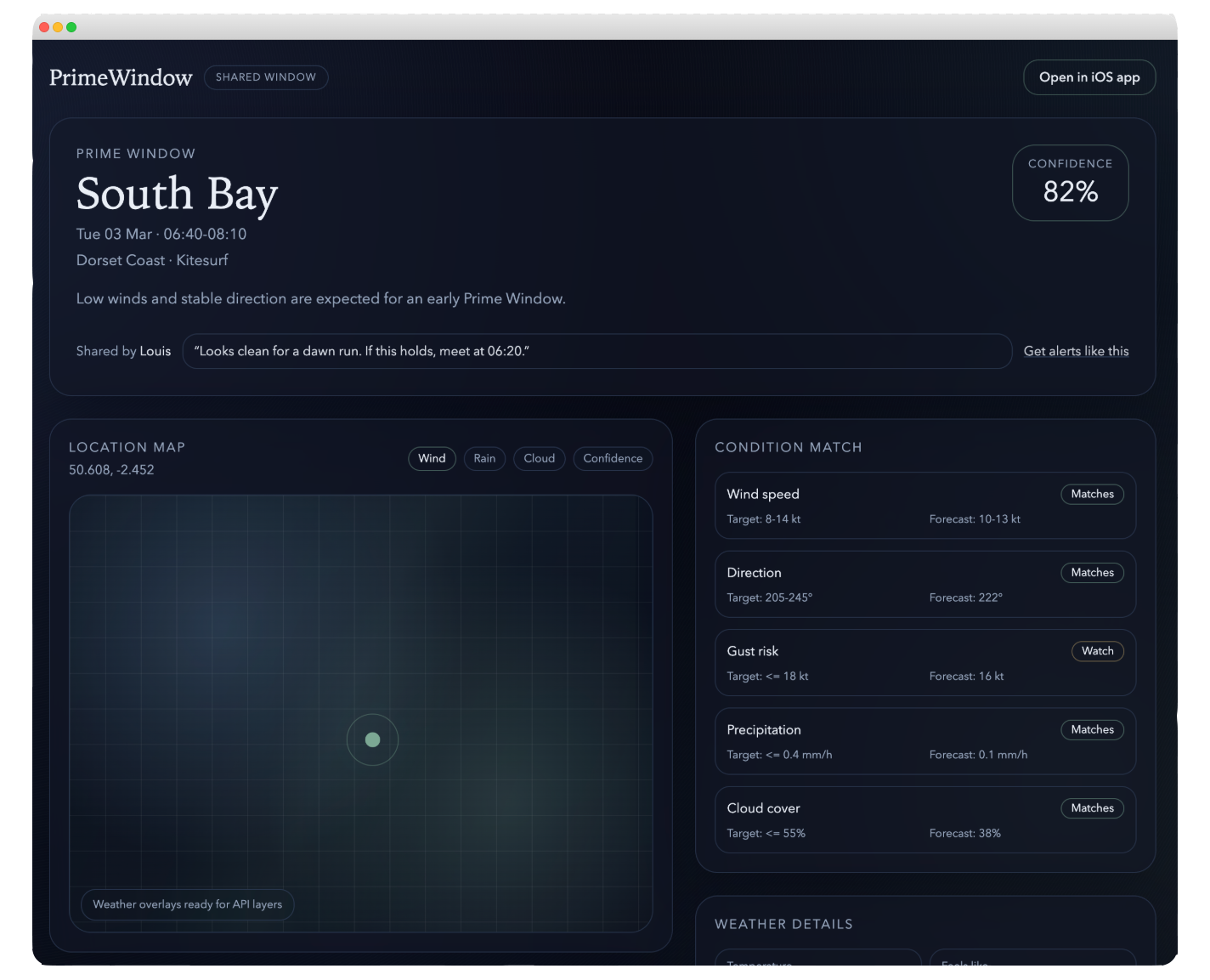
Instead of sending screenshots and debating in group chats, PrimeWindow lets you share a clear, structured window - location, time range, conditions, and confidence - via a simple link.
Presets and standard locations
Another thing I've noticed: everyone ends up recreating the same setup.
If you paraglide in the UK, you probably fly the same hills as everyone else. PrimeWindow will ship with basic sport presets and (soon) standard locations, and you can always customise everything.
Why I'm releasing it
I've been using PrimeWindow myself for a few months now. The biggest difference is how much less time I spend checking weather apps.
I don't constantly reopen forecasts to see if anything changed. I don't sit there trying to interpret three different charts. I just get told when it's worth paying attention.
This isn't venture-funded and it's not designed to become bloated. It's built to solve a specific problem properly.
Pricing
I'd love to make it a one-time purchase. Realistically, weather APIs and infrastructure cost money, so it'll likely be a small subscription with a strong yearly option - something like £0.99/month or £9.99/year - mainly so I'm not out of pocket for running it.
What's next
I'm releasing PrimeWindow for testing soon, with a proper launch not long after.
If you paraglide, sail, kitesurf, climb, fish, shoot - anything that depends on specific conditions - I'd love you to try it.
Get notified when PrimeWindow launches
If you want to be one of the first testers (and get launch details when it's ready), leave your email and I'll let you know.
- Louis